
Berberine Supplement Strengths Explained
A bottle marked 1,000mg can mean at least four different things. Here is how to tell which one you are looking at, with a worked table of four labels.
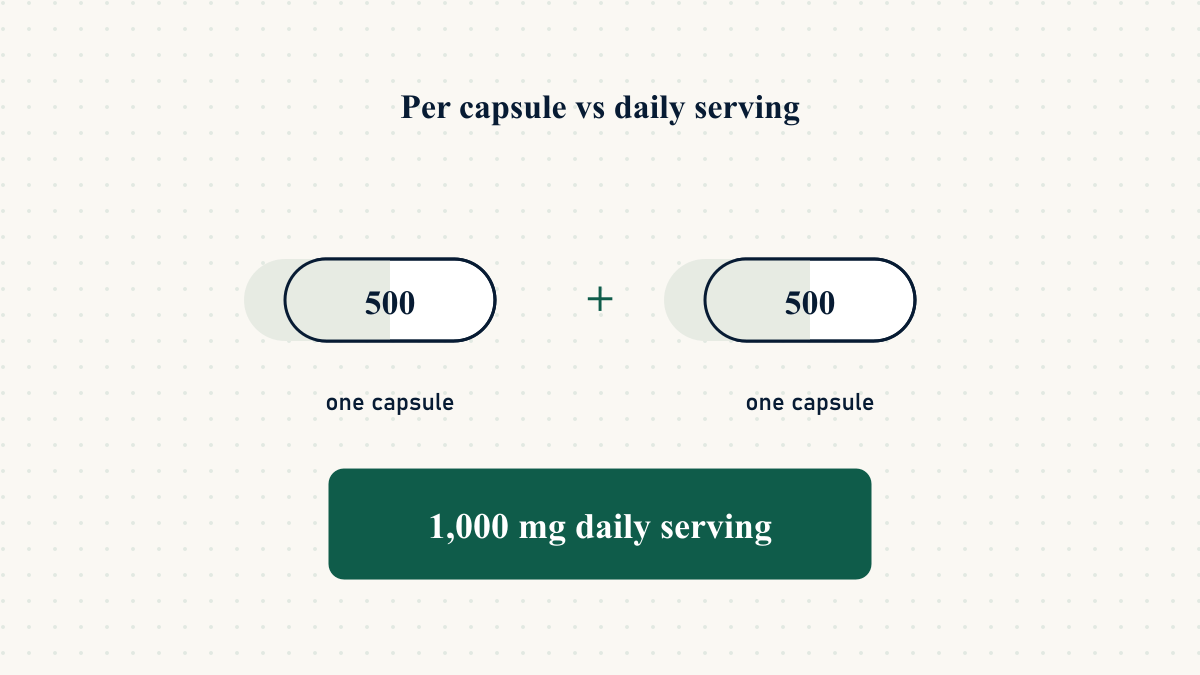
A berberine label quotes strength in two different ways: the amount in one capsule, and the total across the recommended daily serving. A bottle marked 1,000 mg could mean either. It might also be describing the weight of a plant extract rather than the berberine inside it. Here is how to tell which one you are looking at, in about thirty seconds.
Key takeaways
- Per-capsule strength and daily serving are separate figures. Two capsules of 500 mg and one capsule of 1,000 mg give the same daily total from very different bottles.
- The front of the pack is marketing shorthand. The serving information panel carries the declaration that actually counts.
- "1,000 mg" of extract is not "1,000 mg" of berberine. You need the standardisation percentage to bridge the two.
- Berberine HCl and berberine free base are not the same weight either. The salt carries a chloride ion, roughly 10% of the mass.
- Capsule count alone tells you nothing about strength. It tells you how long the bottle lasts.
On this page
The two numbers on every label
Both numbers are always there, even when the front of the pack shows only one. Irish and EU rules require a supplement label to declare the amount present per portion recommended for daily consumption, and to state what that portion is.
Per-capsule strength is what sits inside one capsule. It determines how many capsules you swallow and how fast the bottle empties.
Recommended daily serving is the total across every capsule the manufacturer says makes up a day. It is the only figure that allows a fair comparison between two products.
Multiply the first by the number of capsules in a serving and you get the second. As an example of how that reads in practice, ours states 1,000 mg of berberine HCl per recommended daily serving, provided as two capsules taken with a meal and water, with the full breakdown on the product information page.
Why "1000mg" can mean four different things
"1000mg berberine" printed on a bottle front can legitimately describe any of the following, and all four can appear on labels that meet the rules.
- 1,000 mg of berberine HCl per daily serving, spread across two or more capsules.
- 1,000 mg of berberine HCl in a single capsule, where the serving is one capsule.
- 1,000 mg of a Berberis extract, of which berberine is a stated percentage, so the berberine content is lower.
- 1,000 mg of a blend, where berberine shares the total with other ingredients and its own amount may not be stated at all.
None of these is dishonest in itself. The legally controlled declaration lives in the serving information panel, so look there before you compare anything.
Worked example: four labels compared
Every bottle below has the same thing printed on the front. These are illustrative labels written to show the arithmetic, not real products.
| Front of bottle says | Serving panel says | Berberine per capsule | Capsules per serving | Berberine per daily serving | Capsules needed for 30 days |
|---|---|---|---|---|---|
| 1000mg | 500 mg berberine HCl per capsule, two daily | 500 mg | 2 | 1,000 mg | 60 |
| 1000mg | 1,000 mg berberine HCl per capsule, one daily | 1,000 mg | 1 | 1,000 mg | 30 |
| 1000mg | 1,000 mg Berberis aristata extract at 85% berberine, one daily | 850 mg | 1 | 850 mg | 30 |
| 1000mg complex | 1,000 mg blend, berberine content not stated, two daily | Not determinable | 2 | Not determinable | 60 |
Three things fall out of that table.
Rows one and two deliver an identical daily total from bottles that hold a different number of capsules, so capsule count on its own tells you about bottle life, not strength. Row three shows how a standardisation percentage quietly moves the real figure, which is unpicked properly in extract percentages and standardisation. Row four is the one to walk away from: a blend with no stated berberine content cannot be compared with anything at all.
To turn any of these into days per bottle, divide the capsule count by capsules per serving. Our guide to how long a bottle lasts does the same sum for the common bottle sizes.
Extract weight versus berberine content
An extract is concentrated plant material. Standardisation means each batch is adjusted and tested so it contains a stated percentage of the compound named on the label.
So if a label says 500 mg of extract standardised to 85% berberine, the berberine content is 425 mg. If it says 500 mg berberine HCl, the figure refers to the compound itself. Comparing the first against the second overstates the extract product, sometimes by a lot.
When a label gives an extract weight but no percentage, the sum cannot be completed. That is a transparency problem rather than a maths problem, and there is no way to solve it from the outside.
Salt form and stated weight
Most supplements use berberine hydrochloride rather than the free base. The salt includes the weight of a chloride ion, so a given weight of berberine HCl carries slightly less berberine than the same weight of free base, roughly 10% less. A well-written label states which one the figure refers to.
Berberine HCl is also more soluble in water than the free base, although berberine remains poorly absorbed in absolute terms either way. Both statements are true, and our guide to berberine HCl explained covers the chemistry.
What strengths you actually see on shelves
In practice, Irish and wider EU retail clusters around a small number of configurations. Recognising them makes shelf comparison much quicker.
| Common configuration | Daily total | Typical bottle | Bottle lasts |
|---|---|---|---|
| 500 mg per capsule, two capsules daily | 1,000 mg | 60 capsules | 30 days |
| 500 mg per capsule, two capsules daily | 1,000 mg | 120 capsules | 60 days |
| 500 mg per capsule, one capsule daily | 500 mg | 60 capsules | 60 days |
| 400 mg per capsule, one capsule daily | 400 mg | 90 capsules | 90 days |
| 250 mg per capsule, two capsules daily | 500 mg | 60 capsules | 30 days |
Notice that two bottles holding 60 capsules can last 30 days or 60 days depending only on the serving size, and that two products with the same per-capsule figure can deliver double or half the daily total. Neither of those facts is visible from the front of the pack.
How to read your own label
- Ignore the front of the bottle. Find the serving information panel.
- Note the amount per capsule, and note precisely what substance that amount refers to.
- Note the recommended daily portion in capsules, then multiply to get the daily total.
- Check whether the figure is extract weight or berberine content. If it is extract, find the percentage.
- Check whether it is the salt (berberine HCl) or the free base.
- Divide capsules per bottle by capsules per serving to get days per bottle.
- Follow the directions on the physical label, which take precedence over anything written online, including this page.
If you are comparing products rather than reading one you already own, how to choose a berberine supplement in Ireland turns all of this into a cost-per-day method you can run at the shelf.
Frequently asked questions
Does 1,000 mg on the front of a bottle mean 1,000 mg per capsule?
Not necessarily. It may describe the total across a daily serving of two or more capsules, the content of a single capsule, or the weight of a plant extract of which berberine is only a percentage. The front of a pack is marketing space. The legally required declaration sits in the serving information panel on the back.
Is a one-capsule-a-day product better than a two-capsule one?
Neither is better, they are just packaged differently. A one-capsule serving is simpler to remember and the capsule is usually larger. A two-capsule serving lets you split the dose across the day if the label allows it, and it makes a 60-capsule bottle a neat 30 days. Compare the daily totals, then choose the format you will actually stick to.
How much berberine should I take?
We do not give that advice, and no Irish seller should. The directions on the physical label are the manufacturer's stated recommended daily dose, and you should not exceed them. Whether a supplement is appropriate for you at all, particularly alongside medication or a medical condition, is a conversation for your GP or pharmacist.
Why do two products with the same mg figure cost very different amounts?
Usually because the figures are not measuring the same thing. One may be extract weight and the other the isolated compound, or one may be per capsule and the other per daily serving. Capsule count differs too, so the same price buys a different number of days. Work out cost per day and cost per 1,000 mg before concluding anything.
What is the difference between 500 mg of extract and 500 mg of berberine HCl?
500 mg of berberine HCl is 500 mg of the compound. 500 mg of extract is 500 mg of powder, of which berberine is whatever percentage the label declares: at 85% that is 425 mg, at 97% it is 485 mg. If no percentage is given, the berberine content cannot be worked out at all.
Does capsule count tell me anything about strength?
No. Capsule count tells you how long a bottle lasts once you know the serving size, and nothing more. A 120-capsule bottle at two capsules a day lasts 60 days. A 60-capsule bottle at one capsule a day also lasts 60 days. Strength comes from the per-capsule figure and the serving size together.
Where should I look if my label is unclear?
Start with the serving information panel and the ingredient list on the physical packaging, which is the legally controlled text. If the berberine content still cannot be worked out, contact the business named on the label, since its name and address must appear there. A supplier who cannot answer a straight question about its own serving panel is not being transparent.
Sources and further reading
- Food Safety Authority of Ireland. Food supplements, business advice. fsai.ie. Accessed 13 August 2026.
- Food Safety Authority of Ireland. Guidance Note 21: food supplements regulations and notifications. fsai.ie. Accessed 13 August 2026.
- Food Safety Authority of Ireland. Nutrition labelling. fsai.ie. Accessed 13 August 2026.
- PubChem, National Library of Medicine. Berberine chloride (CID 12456). pubchem.ncbi.nlm.nih.gov. Accessed 13 August 2026.
- Comprehensive analysis of Berberis aristata DC. bark extracts. Nutrients, 2024. pmc.ncbi.nlm.nih.gov. Accessed 13 August 2026.