
Extract Percentages and Standardisation Explained
Two bottles can both say 500mg and hold very different amounts of berberine. Here is the worked table that shows exactly how far apart they can be.
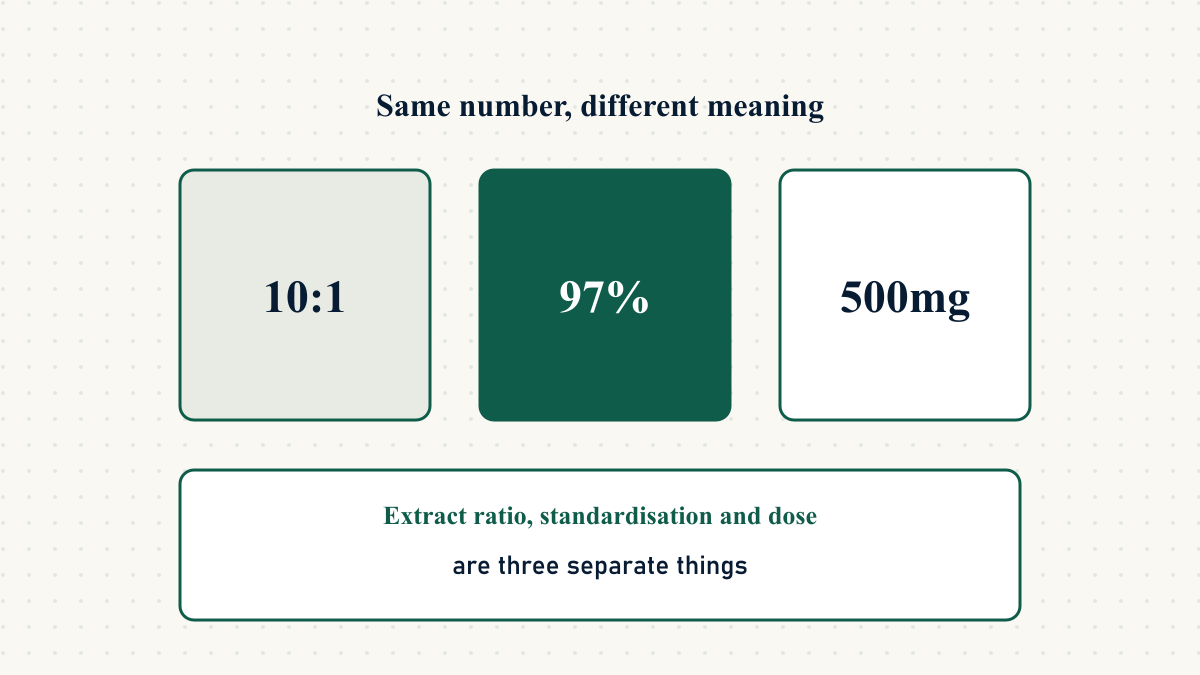
Two products can both print "500 mg" on the box and hold very different amounts of berberine. One might contain 452 mg, another 385 mg, another an amount that cannot be worked out at all. The difference comes down to two small pieces of label wording: an extract ratio and a standardisation percentage. Here is how to read both.
Key takeaways
- The same "500 mg" can mean anything from about 452 mg of berberine to an amount the label does not let you calculate.
- A standardisation percentage ("standardised to 97% berberine") states what proportion of the powder is the named compound. This is the number you can do sums with.
- A ratio ("10:1") is a manufacturing statement about concentration relative to raw plant material. It tells you nothing at all about berberine content.
- Extract weight × standardisation percentage = compound content. If either half is missing, no honest comparison is possible.
- Check whether a percentage names berberine or berberine HCl, because the salt is only about 90.5% berberine by weight.
On this page
The same 500 mg, five different meanings
Start here, because the table does more work than any explanation. Every row below states 500 mg. The berberine content differs in every single case. Figures are rounded and assume the anhydrous salt.
| What the label says | What the 500 mg measures | Berberine HCl in the dose | Berberine (cation) in the dose |
|---|---|---|---|
| Berberine HCl 500 mg | The isolated salt | 500 mg | about 452 mg |
| Berberis aristata extract 500 mg, standardised to 97% berberine HCl | The extract powder | about 485 mg | about 439 mg |
| Berberis aristata extract 500 mg, standardised to 85% berberine | The extract powder | about 425 mg if declared as the salt | about 385 mg as the salt, 425 mg as the cation |
| Berberis aristata root extract 500 mg (10:1) | The powder, with no compositional statement | Not declared | Not declared. About 5 g of dried bark equivalent |
| Berberis aristata root and stem bark powder 500 mg | Milled raw bark, not an extract | Not declared | Not declared, and far lower than any extract |
The gap between the first row and the last is the whole point. All five bottles could sit beside each other on a shelf showing the same number. A larger figure is not preferable, it is simply not comparable, and the rest of this guide explains where each of those numbers comes from.
What "standardised to X%" means
Standardisation means the manufacturer adjusts and tests the extract so a named compound falls within a defined range, then declares it. "Standardised to 97% berberine" means 97% of the powder by weight is berberine, verified analytically, usually by high-performance liquid chromatography.
This is the number you can calculate with, and it is also where wording matters most. "97% berberine" and "97% berberine HCl" are not identical. As covered in our guide to what HCl means on a berberine label, the salt is about 90.5% berberine by mass, because berberine chloride weighs about 372 g/mol against about 336 g/mol for the berberine cation, using the values published by PubChem.
Does declared content match reality? A 2024 analysis in Nutrients tested commercial Berberis aristata bark extracts and found material declared at 97% measured 96.60% plus or minus 1.91%, while material declared at 85% measured 87.76% plus or minus 3.64%. That describes the raw-ingredient market rather than any individual finished product. Our own extract is standardised to 97% berberine, and for any specific bottle, including the serving information for ours, the physical label is the document that counts.
What a 10:1 extract ratio means
The technical term is the drug-extract ratio, or DER. The ConPhyMP guidelines, a peer-reviewed consensus on characterising plant extracts published in Frontiers in Pharmacology, define it as the amount of extract obtained from the amount of herbal drug, varying with solvent and process. In a 10:1 extract, roughly 10 kg of dried plant material yields 1 kg of extract.
| Stated ratio | Dried plant material behind a 500 mg dose | Berberine content |
|---|---|---|
| 4:1 | about 2,000 mg (2 g) | Not stated by the ratio |
| 10:1 | about 5,000 mg (5 g) | Not stated by the ratio |
| 20:1 | about 10,000 mg (10 g) | Not stated by the ratio |
Two cautions. A ratio only means something alongside the extraction solvent, because water and alcohol pull different compounds out of the same bark, which is why ConPhyMP treats the solvent as required information. And a higher ratio does not automatically mean more berberine, only that more starting material was reduced into the same weight of powder. A 20:1 extract sounds impressive and can still be poorer in berberine than a 4:1 one.
Two different numbers on one label
Labels routinely mix two unrelated measurements. One describes a manufacturing process, the other chemical composition, and both appear as numbers beside a plant name.
- Ratio (4:1, 10:1, 20:1). A process statement about concentration relative to raw plant material.
- Percentage (85%, 97%). A composition statement about how much of a named compound the powder contains.
- Milligram figure (500 mg). The weight of material in the capsule, which may be extract, isolated compound or raw powder.
You need at least two of the three to know what you are actually taking. A milligram figure with a percentage is enough. A milligram figure with only a ratio is not.
How to tell which number a label declares
- Look for the word "extract". A milligram figure beside it is the weight of powder, not of berberine.
- Look for a colon. A ratio such as 10:1 is a process statement and gives no berberine amount on its own.
- Look for "standardised to". This introduces the percentage you can calculate with.
- Check whether the percentage names berberine or berberine HCl. The difference is roughly 10% of the weight.
- Check what the figure is "per". Per capsule and per daily serving are different numbers, as covered in berberine supplement strengths.
- Check species and plant part, which is where the plant behind the label comes in.
Irish and EU rules require labels to declare the amount of substances with a nutritional or physiological effect per the portion recommended for daily consumption, and to state that portion, so the information should be there to find. The Food Safety Authority of Ireland sets out those requirements, and our guide to reading food supplement labels in Ireland covers the rest of the panel.
Where these numbers stop telling you much
A percentage tracks one marker compound and no more. Research published in PLoS One in 2016 tested eight commonly used herbs and reported that the level of a marker compound does not necessarily correlate with biological activity across commercial sources. Standardising makes batches consistent with each other. It does not turn the number into a measure of anything else.
A percentage also says nothing about the rest of the powder. A 97% extract still holds 3% of other material, largely related alkaloids such as jatrorrhizine and palmatine. And no percentage tells you anything about absorption, which is low in absolute terms for berberine whatever the form, or about botanical identity, which is a matter for the supplier's testing rather than the front of the pack.
Working out how much berberine sits in a serving is a labelling exercise. It is not a reason to seek more of it, and this guide recommends no amount.
Frequently asked questions
Is 500 mg of extract the same as 500 mg of berberine?
No. A 500 mg extract figure is the weight of the whole powder, and the berberine content depends on the standardisation percentage: at 97% it is about 485 mg of berberine HCl, at 85% about 425 mg. If no percentage is given, the berberine amount cannot be calculated at all. Only a label declaring berberine itself, or an extract weight plus a percentage, gives you a usable figure.
What does 10:1 mean on an extract?
It is the drug-extract ratio: roughly 10 units of dried plant material produced one unit of extract, so 500 mg of a 10:1 extract corresponds to about 5 g of dried bark. It describes concentration relative to the raw plant, not composition, and on its own it tells you nothing about how much berberine is present.
Is a 97% extract better than an 85% extract?
Neither is better. The percentage is a manufacturing and analytical specification, not a measure of quality or effect. A higher figure simply means more of the powder is the named compound and less of it is other plant material. It is composition information, and we do not present any percentage as producing a benefit.
Why does berberine HCl versus berberine matter in a percentage?
Because the salt includes a chloride counter-ion that adds weight. Berberine chloride weighs about 372 g/mol while the berberine cation weighs about 336 g/mol, so the salt is roughly 90.5% berberine. A label declaring 97% berberine HCl and one declaring 97% berberine therefore describe slightly different amounts of the same underlying molecule.
Do extracts actually contain what the label says?
A 2024 analysis in Nutrients tested commercial Berberis aristata bark extracts and found material declared at 97% measured 96.60% plus or minus 1.91%, and material declared at 85% measured 87.76% plus or minus 3.64%. That is reassuring about the raw-ingredient market in that study, but it says nothing about any individual finished product, which comes down to the supplier's own testing.
What is in the other 3% of a 97% extract?
Mostly related plant alkaloids from the same bark, such as jatrorrhizine and palmatine, together with residual plant material and moisture. A standardisation percentage only describes the named compound, so nothing on the label characterises the remainder unless the manufacturer chooses to publish a fuller specification.
Should I just choose the highest number I can find?
No. A larger figure is composition information, not a benefit, and the numbers frequently are not measuring the same thing anyway. Work out extract weight × standardisation percentage for each product so you are comparing like with like, then follow the dose on the physical label and ask your GP or pharmacist if you are unsure whether a supplement suits you.
Sources and further reading
- Heinrich M, et al. The ConPhyMP guidelines on chemical characterisation of extracts. Frontiers in Pharmacology, 2022. pmc.ncbi.nlm.nih.gov Accessed 13 August 2026.
- Comprehensive analysis of Berberis aristata DC. bark extracts. Nutrients, 2024. pmc.ncbi.nlm.nih.gov Accessed 13 August 2026.
- A lack of bioactive predictability for marker compounds used in herbal standardisation. PLoS One, 2016. pmc.ncbi.nlm.nih.gov Accessed 13 August 2026.
- PubChem, National Library of Medicine. Berberine chloride (CID 12456). pubchem.ncbi.nlm.nih.gov Accessed 13 August 2026.
- Food Safety Authority of Ireland. Food supplements. fsai.ie Accessed 13 August 2026.