
Berberine Ireland 2026: Dosage, Side Effects and Benefits
What berberine is, what the research has measured, how much people take, who should be careful, and the label maths that shows which product is genuinely better value.
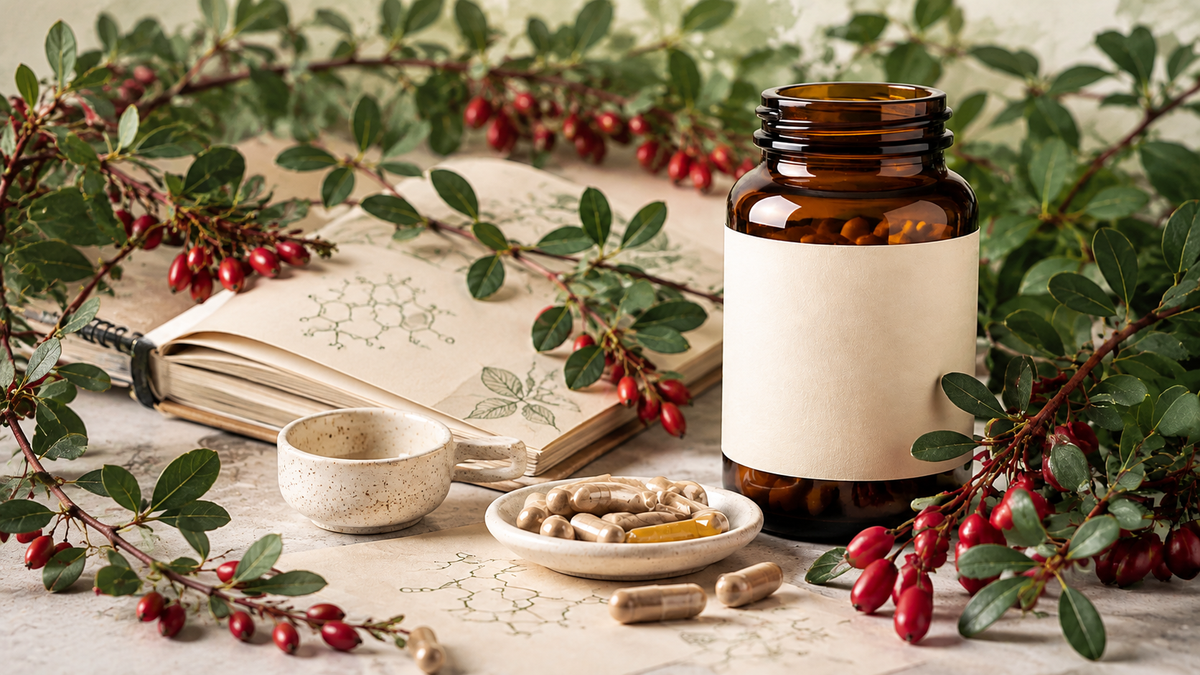
Two bottles sit beside each other on the same shelf. Both say 500mg berberine on the front. One of them contains roughly ten times more of the actual compound than the other, and nothing on the front of either bottle tells you which one you are holding.
That is not a scandal. It is just how supplement labelling works, and it is entirely legal. But it does mean that most people comparing berberine in Ireland are comparing the wrong number, and a fair few of them are paying more per day for less.
So this guide does two jobs.
The first half covers what berberine is, what researchers have actually measured, how much people take, and who genuinely needs to be careful with it.
The second half teaches you the label maths, so you can work out what is in any bottle in about thirty seconds and stop being sold to on the strength of a big number in a nice font.
We sell berberine, so factor that in. We have also written the bit that tells you how to check us against everyone else, because a page that only makes sense if you do not read it carefully is not worth publishing.
- 1,000mg per daily serving
- 97% standardised extract
- 50 µg chromium
- From €29.97 delivered in Ireland
The short version
- Berberine is sold in Ireland as a food supplement. It is not a medicine and it is not a substitute for one.
- Most research uses daily amounts split across the day, taken with meals, over a period of weeks rather than days.
- The most commonly reported side effects are digestive, and they are usually worse when people start high.
- Interactions are the real reason to be careful. If you take prescription medication, ask your pharmacist first.
- Labels vary enormously. Two bottles both saying "berberine 500mg" can contain very different amounts of the active compound.
What is on this page
- What berberine actually is
- Buying it in Ireland without getting stung
- How to read a berberine label properly
- What the research has looked at
- Dosage: what studies use, and what people do
- Side effects and who should be careful
- Medication interactions
- Berberine compared with other things
- How long before you would know
- Working out the real cost per day
- Questions people actually ask
- Sources
What berberine actually is
At a glance. Berberine is a bright yellow compound found in a handful of plants, most commonly sold in Ireland as capsules made from Berberis aristata bark extract. It has been studied in adults for markers connected to metabolic health. The research is genuinely interesting and genuinely mixed, which is a boring answer but an honest one.
Berberine is what is called an alkaloid, a naturally occurring plant compound. You will find it in barberry, goldenseal, Oregon grape and tree turmeric, among others. It is the thing that makes those plants that startling yellow colour, and it has been used in traditional preparations across several cultures for a very long time.
None of that history tells you whether it does anything, which is worth saying plainly. Plenty of traditional remedies turned out to do nothing much under scrutiny. What makes berberine interesting is that it has been put through a reasonable number of human trials in adults, and researchers keep coming back to it.
If you are searching for berberine in Ireland, you are almost certainly trying to answer one of three questions:
- Is this safe for me, given what I already take?
- How much do people take, and for how long before they would know anything?
- Which product is actually good value, rather than just cheap?
This guide works through all three. We sell berberine, so read this with that in mind, but we have tried to write the page we wanted to find when we were first comparing products ourselves.
Buying it in Ireland without getting stung
At a glance. Berberine is widely available in Ireland from pharmacies, health shops and online retailers. The main things worth checking are the declared amount per serving, whether the extract standardisation is printed, and whether the price includes delivery to an Irish address without customs surprises.
The awkward part of buying supplements is that the packaging is designed to sell, not to inform. A few habits make it much easier.
A checklist worth using
- The label states the amount per daily serving, not just per capsule, and tells you how many capsules a serving is.
- The extract standardisation is printed as a percentage. If it is missing, you cannot work out what you are getting.
- The plant source is named. Berberis aristata, for example, rather than just "berberine complex".
- Prices are in euro and delivery is from within the EU, so nothing lands you with a customs charge.
- The seller is contactable and has a returns policy you can actually read.
A small thing that saves money
Work out the cost per day before you compare bottles. A cheaper bottle with a smaller serving size is often the more expensive product once you divide it out. There is a worked example further down this page.
How to read a berberine label properly
At a glance. This is the section most guides skip, and it is the one that saves you the most money. "500mg berberine" on the front of a bottle can mean several different things, and the difference between them is large.
Here is the thing that trips almost everyone up. When a label says the product contains a given amount of berberine, that number can refer to one of two quite different quantities.
It might mean the amount of plant extract in the capsule. Or it might mean the amount of berberine in that extract. Those are not the same number, and the gap between them depends entirely on how concentrated the extract is.
An extract standardised to 97% is nearly all berberine. An extract at 10% is mostly other plant material. Same word on the front of the bottle, roughly a tenfold difference in what you are actually swallowing.
| What the label says | What it might mean | What to look for instead |
|---|---|---|
| "Berberine 500mg" | Either 500mg of extract, or 500mg of berberine within a larger amount of extract | A standardisation percentage printed somewhere on the label |
| "Berberine complex" | A blend, with the individual amounts often not declared | Each ingredient listed with its own amount in mg |
| "Proprietary blend" | A total weight only, with the split between ingredients hidden | Avoid, or accept you cannot compare it with anything else |
| "Per capsule" | Says nothing about how many capsules a serving is | The per-serving figure and the serving size together |
Our own product declares 1,000mg per daily serving from an extract standardised to 97%, alongside 50 µg of chromium and black pepper extract standardised to 95% piperine. We print all of it because we think you should be able to do this comparison, including against us.
What the research has looked at
At a glance. Human trials in adults have measured markers linked to glucose and lipid metabolism, along with body weight measures in some studies. Study quality and size vary a great deal, and results differ between individuals. Treat all of it as an area of active research rather than a settled question.
This is the section where supplement pages usually get carried away, so we will be careful.
What follows is a description of what researchers have chosen to measure. It is not a statement about what a supplement will do for you, and nobody selling you berberine is in a position to tell you that.
Markers that come up repeatedly in the literature
- Fasting glucose and HbA1c in adult trials
- Total cholesterol, LDL and triglycerides
- Body weight and waist circumference in a subset of studies
- Markers associated with inflammation
- Effects on gut bacteria, mostly at an early stage and often in animals
Setting your expectations honestly
A few things are worth internalising before you spend anything.
Effects reported in studies tend to be modest, and they sit on top of diet and activity rather than replacing them. If nothing else in your routine changes, do not expect much.
Studies typically run for weeks or months, not days. People also respond differently, which means the average result in a trial may not be your result.
The honest summary is that berberine is one of the more studied plant compounds in this space and that the research is still arguing with itself. Anyone telling you it is settled is selling something, ourselves included if we ever say it.
Dosage: what studies use, and what people do
At a glance. Trials commonly use a total daily amount split into two or three doses taken with food. Starting at the full amount on day one is the most common cause of a bad first week. Build up instead.
A sensible way to start
- Start low. Take less than the full serving for the first few days and see how you get on.
- Take it with food. This is the single change that most often settles digestive complaints.
- Split it. Where a product allows, spreading the serving across the day tends to be tolerated better than one large dose.
- Be boring about it. Consistency matters more than precision. Missing days at random tells you nothing.
- Set a review date. Pick a point four to eight weeks out and decide then, rather than reassessing every few days.
| Stage | What studies tend to do | Practical version | Worth knowing |
|---|---|---|---|
| First week | Lower starting amounts | Half serving, with meals | Digestive complaints peak here |
| Building up | Increase gradually | Move to full serving if comfortable | No prize for rushing |
| Ongoing | Daily use across weeks | Same time, same routine | Switching brands resets your read |
| Review | 4 to 12 week windows | Decide at 4 to 8 weeks | Stop sooner if anything worries you |
This is general information about what appears in the literature, not personal advice. If you take medication, particularly anything affecting blood glucose, do not experiment on yourself without talking to a professional first.
Side effects and who should be careful
At a glance. Most reported side effects are digestive and most are associated with higher amounts or with starting too quickly. Berberine is not suitable for everyone, and pregnancy and breastfeeding are clear exclusions.
What people most often report
- Stomach upset, cramping or a general unsettled feeling
- Nausea, particularly when taken without food
- Changes in bowel habit in either direction
- Headache, less commonly
Most of these are reported early and often settle. If something persists, stop taking it and talk to a pharmacist or GP. That is not a formality, it is the sensible thing to do.
People who should not take it without advice
- Anyone pregnant or breastfeeding
- Anyone taking prescription medication of any kind
- Anyone with surgery scheduled
- Anyone managing an ongoing health condition
- Anyone under 18
Important. Food supplements are not a substitute for a varied and balanced diet or a healthy lifestyle. This product is for adults aged 18 and over. Do not exceed the stated daily amount.
If you are pregnant, breastfeeding, taking any medication or under medical supervision, speak with your doctor or pharmacist before use. Stop taking it and seek advice if you experience any adverse reaction. Keep out of reach of children.
Medication interactions
At a glance. This is the part of the page we would most like you to read. Berberine has been discussed in research in relation to the pathways your body uses to process medicines, which means the potential for interaction is real rather than theoretical.
Your liver processes most medications through a set of enzyme systems. Anything that changes how busy those systems are can, in principle, change how much of a medicine ends up in your bloodstream.
That can push levels up or down. Neither is good if you are relying on a prescribed dose being the dose you actually get.
Categories worth raising specifically with your pharmacist:
- Anything for blood glucose management
- Blood pressure medication
- Anticoagulants and antiplatelet medicines
- Immunosuppressants
- Anything with a narrow margin between an effective dose and a problematic one
A pharmacist consultation costs you nothing in Ireland and takes about five minutes. Bring the bottle or a photo of the label. We would rather lose the sale than have you skip that conversation.
Berberine compared with other things
At a glance. Berberine gets compared to prescription medicines online, often carelessly. A food supplement and a licensed medicine are different categories with different evidence requirements. They are not alternatives to one another.
| Comparison | What is actually being compared | Sensible takeaway |
|---|---|---|
| Berberine and prescription medicines | A food supplement against a licensed medicine | Different categories entirely. Never stop or change prescribed medication on the strength of a supplement. |
| Berberine and cinnamon | A standardised extract against a kitchen spice | Dose control is far tighter with a standardised extract. That cuts both ways. |
| Berberine and dihydroberberine | Two related compounds sold at very different prices | Compare the declared amounts and the price per day before assuming newer means better. |
| Berberine on its own or with chromium | Single ingredient against a combination | Check the combination declares every amount. If it hides them in a blend, you cannot judge it. |
How long before you would know
At a glance. Studies generally assess outcomes over weeks. A four to eight week window is a reasonable point to review, provided you keep everything else roughly steady.
The most common mistake is changing five things at once and then trying to work out which one mattered. If you start a supplement the same week you overhaul your diet, join a gym and change your sleep, you have learned nothing about the supplement.
- Week one. This is about tolerance and building a habit, nothing more.
- Weeks two to four. Any digestive pattern has usually settled or become clearly unacceptable by now.
- Weeks four to eight. A fair point to decide whether to continue.
Working out the real cost per day
At a glance. Bottle price tells you very little. Divide the price by the number of days the bottle actually lasts at the stated serving, and compare that number instead.
This is straightforward arithmetic that almost nobody does at the shelf, and it changes which product looks best surprisingly often.
It is two steps.
- Capsules in the bottle, divided by capsules in a daily serving. That is how many days it lasts.
- Price, divided by that number. That is your cost per day.
Here is why it matters:
| Bottle | Serving | Days it lasts | Cost per day |
|---|---|---|---|
| €15, 60 capsules | 3 a day | 20 days | 75 cent |
| €30, 60 capsules | 2 a day | 30 days | €1.00 |
The dearer bottle costs 25 cent a day more, not double what the shelf price suggests. Once you have that number for each product, you can compare what is actually in each serving.
Do that across every product you are considering, including ours. If a competitor comes out ahead on cost per day at the same declared amount and standardisation, buy theirs.
Questions people actually ask
Can I buy berberine in Ireland?
Yes. It is sold as a food supplement through pharmacies, health shops and online retailers. Buying from within the EU avoids customs charges and usually means faster delivery.
Do I need a prescription?
No. Berberine is sold as a food supplement rather than a medicine, so no prescription is involved. That also means it has not been through the approval process a medicine goes through, which is worth keeping in mind.
When is the best time to take it?
With meals is the most common approach in studies and the one people tolerate best. Where a serving can be split, spreading it across the day tends to be gentler than taking it all at once.
How long do people take it for?
Study periods commonly run from four to twelve weeks. In practice, four to eight weeks is a sensible point to stop and reassess rather than continuing indefinitely by default.
What does the standardisation percentage mean?
It tells you how much of the extract is the compound you are buying. An extract standardised to 97% is almost entirely berberine. A much lower percentage means most of what is in the capsule is other plant material. Without that figure you cannot compare two products meaningfully.
Why do some products include black pepper extract?
Black pepper extract standardised for piperine is a common inclusion across the supplement category. Ours contains it at 95% standardisation and we declare the amount on the label.
Can I take it alongside my medication?
Ask your pharmacist before you do. Interactions are the main safety consideration with berberine, and a pharmacist can check against what you are actually prescribed in a few minutes.
Is it suitable if I am vegan?
That depends on the capsule. Ours uses HPMC capsules, which are plant based. Gelatin capsules are not. The label will say.
Where to go next
If one part of this raised a question, these go deeper:
- Still deciding whether to buy at all? What berberine is and what HCl actually means on a label.
- Comparing products? Extract percentages explained, how strengths compare, and how to choose one in Ireland.
- Worried about safety? Side effects in detail, berberine and medicines, and pregnancy and breastfeeding.
- Already bought some? When to take it, whether to take it with food, and how long a bottle should last.
Sources
- National Center for Complementary and Integrative Health, Goldenseal. Background on berberine-containing plants.
- National Library of Medicine, LiverTox: Berberine. Overview of research and safety reporting.
- European Commission, EU Register of nutrition and health claims. The register of claims permitted on food supplements in the EU.
- Health Products Regulatory Authority, HPRA. Irish regulator for medicines and health products.
About this guide
Written by Aoibhaoin Walsh for Berberine.ie. We sell a berberine supplement, which you should factor in when reading anything on this page. Our approach is to publish the numbers and let you compare, including against products that are not ours. If you spot something here that is wrong or out of date, tell us and we will fix it.
This article is general information only. It is not medical advice and it is not a substitute for talking to a qualified professional about your own situation.